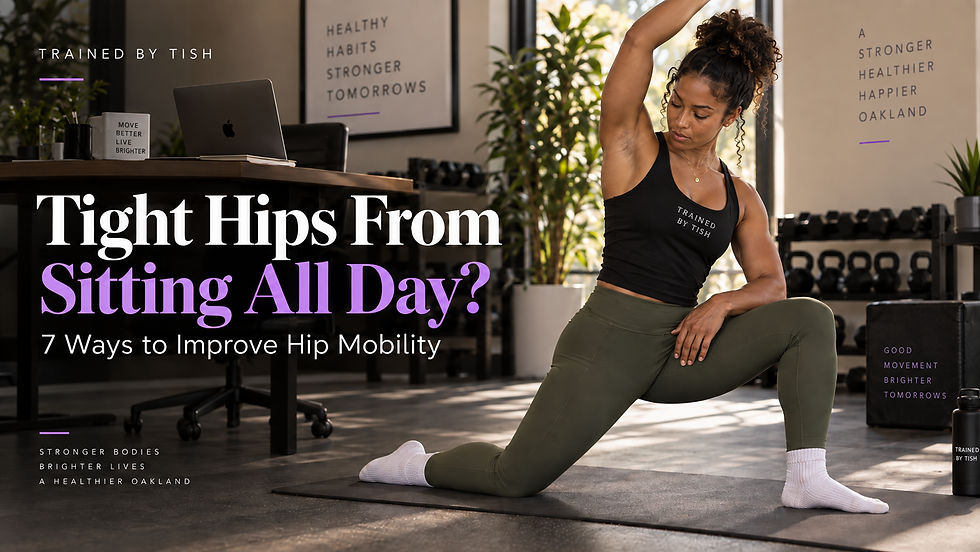
Tight Hips From Sitting All Day? 7 Ways to Improve Hip Mobility

You stand up after hours at your desk and immediately notice it.
Your hips feel stiff.
Your lower back feels tight.
The first few steps feel like your body needs a minute to remember how to move again.
Sound familiar?
For people who spend much of the day working at a desk, sitting in meetings, commuting, or driving around the Bay Area, hip tightness can become part of the daily routine.
And while searching for stretches for tight hips might give you hundreds of exercises to choose from, improving how your hips feel usually requires more than randomly stretching for a few minutes whenever they become uncomfortable.
Mobility involves movement, flexibility, strength, and control.
The good news?
You don't need an hour-long mobility routine every day.
A few intentional changes can make mobility work much easier to incorporate into your schedule.
Here are seven ways to start improving hip mobility—especially if sitting takes up a large part of your day.
Why Do Your Hips Feel So Tight After Sitting?
Your hips are designed to move through several directions.
They flex when you bring your knee toward your chest, extend when your leg moves behind you, and rotate as you walk, squat, run, and change direction.
But when you sit for extended periods, your hips spend a lot of time in roughly the same flexed position.
That's one reason many people notice tight hip flexors or stiffness after spending hours at a desk or in a car.
And your hips don't work alone.
The muscles around your hips, glutes, core, pelvis, and lower back all contribute to how you move.
So if you're experiencing lower back and hip tightness, repeatedly stretching one muscle may not address everything contributing to the way you feel.
A better goal is to get your body moving more often while combining mobility work with strength.
1. Break Up Long Periods of Sitting
Before adding complicated hip mobility exercises, start with the simplest strategy:
Get up more often.
You don't need to perform a complete workout every time you leave your desk.
Stand up.
Walk to get some water.
Take a quick lap around the office.
Walk during a phone call.
Do a few bodyweight movements.
The goal is simply to change positions.
For Oakland and Bay Area professionals, this can be especially important when the workday includes both desk time and a long commute.
If you sit for eight hours at work and then spend another hour sitting in traffic, a five-minute stretch at the end of the day is trying to compensate for a lot of time spent in one position.
Think of mobility as something you practice throughout your day rather than something you save exclusively for the gym.
2. Try a Half-Kneeling Hip Flexor Stretch
One of the most useful stretches for tight hips is also one of the simplest.
Start in a half-kneeling position with one knee on the ground and the opposite foot planted in front of you.
Keep your torso tall.
Gently tuck your pelvis rather than dramatically arching your lower back.
From there, slowly shift forward until you feel a comfortable stretch through the front of the hip on the kneeling side.
Hold the position while breathing normally, then switch sides.
The key word is comfortable.
You shouldn't need to force yourself deeper into a stretch to make it effective.
If your lower back arches dramatically as you move forward, you may simply be creating movement through your spine instead of getting the hip position you intended.
Slow down and focus on control.
This can be a useful addition to your routine after a long day of sitting or before a workout that requires significant lower-body movement.
3. Add the 90/90 Hip Stretch
Hip mobility isn't only about moving your leg forward and backward.
Rotation matters too.
The 90/90 stretch is popular because it allows you to work on hip rotation in a controlled seated position.
Sit with one leg positioned in front of you and your other leg positioned beside or slightly behind you, with both knees bent.
Instead of forcing your knees toward the floor, focus on sitting tall and finding a position you can control.
Depending on your current mobility, simply holding the position may provide plenty of challenge.
As it becomes more comfortable, you can gradually explore leaning forward or transitioning from one side to the other.
This is one of those hip mobility stretches where there is no prize for forcing yourself into the position you saw someone perform on Instagram.
Meet your body where it is.
Mobility is something you build.
4. Strengthen Your Glutes With Bridges
Stretching isn't the only way to address hips that feel stiff.
Strength matters too.
Your glutes play an important role in extending and stabilizing your hips, which makes exercises such as glute bridges valuable additions to a mobility-focused routine.
Lie on your back with your knees bent and your feet planted on the floor.
Brace your midsection gently, press through your feet, and lift your hips from the floor while squeezing your glutes.
Pause at the top without excessively arching your lower back, then slowly lower yourself down.
This is a good example of why mobility and strength shouldn't be treated as completely separate categories.
Sometimes the goal isn't simply getting a muscle to stretch farther.
You also want your body to become stronger and more controlled throughout the movement available to you.
That strength-and-mobility philosophy is incorporated into personal training at Trained By Tish, where mobility work is included as part of individualized programming.
5. Practice Controlled Hip Rotation
Another way to improve hip mobility is to actually practice moving your hips through different ranges of motion.
One simple option is controlled standing hip rotations.
Stand near a wall or sturdy surface for balance.
Slowly lift one knee toward your chest, rotate it outward, and bring the leg around before returning to your starting position.
Then reverse the movement.
The objective isn't speed.
Move slowly enough that you're controlling the motion rather than swinging your leg around.
You may notice that one hip moves differently from the other.
That's okay.
Mobility doesn't need to look identical from person to person—or even from one side of your own body to the other.
Pay attention to what you can control and gradually work from there.
6. Build Strength Through Squats, Hinges and Lower-Body Training
If you want your hips to move well during everyday life, training the muscles around them is important.
Squats, deadlift variations, split squats, step-ups, and other lower-body movements can all be part of building strength around the hips.
That doesn't mean you need to start loading a barbell tomorrow.
Exercise selection should match your current abilities and goals.
A beginner may start with a bodyweight squat to a bench.
Someone with more experience might use dumbbells, kettlebells, or barbells.
What matters is learning how to control movement and progressively build strength.
This is one reason simply searching for the "best stretch for tight hips" doesn't always tell the whole story.
Mobility without strength can leave part of the equation unfinished.
You want enough mobility to access useful positions and enough strength to control yourself within them.
If you're unsure how to combine mobility and strength, one-on-one personal training can give you programming based on your body, goals, training history, and current ability.
You can also explore small group training if you prefer professional coaching in a community environment.
7. Consider Assisted Stretch Therapy
Sometimes stretching on your own just isn't the same as being able to relax while someone else guides you through the movement.
That's where assisted stretch therapy can help.
During an assisted stretch session, your stretch therapist moves and positions your body through guided stretches based on your needs.
Instead of trying to balance, maintain the position, and decide how far to stretch all at once, you can focus on breathing and relaxing while the therapist guides the session.
At Trained By Tish, stretch therapy is designed around releasing tension, improving flexibility, restoring movement, and helping you move and recover better.
It can be particularly useful if your hips constantly feel tight despite doing mobility exercises on your own.
Learn more about assisted stretch therapy in Oakland.
Sessions are available in both 60-minute and 90-minute options, allowing the experience to be tailored to how much dedicated mobility and recovery work you want.
Try This After Sitting All Day
You don't necessarily need a complicated routine when you get home from work.
A simple mobility sequence might involve getting up and walking for several minutes, performing your half-kneeling hip flexor stretch, spending some time in the 90/90 position, completing controlled hip rotations, and finishing with a few glute bridges.
The exact exercises matter less than building the habit of moving consistently.
You could even break the routine apart throughout the day.
Do one movement between meetings.
Walk around the block at lunch.
Stretch after your commute.
Perform your strength workout later.
Mobility doesn't have to happen in one perfect 30-minute window.
Stretching Shouldn't Feel Like a Battle With Your Body
There's a big difference between normal stretching tension and pain.
More discomfort doesn't automatically produce better mobility.
If an exercise creates sharp pain, significant pinching, numbness, or symptoms that concern you, forcing yourself deeper into the position isn't the answer.
Persistent or significant hip or lower-back pain can have many causes and may need to be evaluated by an appropriate healthcare professional.
For everyone else, improving mobility is usually better approached as a gradual process.
Your hips didn't become stiff because you skipped one day of stretching.
And they probably won't feel completely different because you did one mobility routine.
Give your body consistent opportunities to move.
Hip Mobility Is About More Than Touching Your Toes
When people hear "mobility," they sometimes picture extreme flexibility.
That's not the goal.
Useful mobility means being able to move through the ranges of motion your life and training require while maintaining control.
That might mean squatting more comfortably.
Walking without feeling stiff after leaving your desk.
Getting through a workout without feeling like your hips need 20 minutes to loosen up.
Moving more comfortably after your commute.
Or simply standing up at the end of the workday and feeling like your body is ready to move.
That's why strength and mobility work so well together.
You aren't trying to become flexible just for the sake of being flexible.
You're trying to move better.
Ready to Give Your Hips Some Attention?
If you've spent months searching for stretches for tight hips, repeatedly following mobility videos, and still feel like your body needs more focused attention, it may be time to make recovery a more intentional part of your routine.
At Trained By Tish in Oakland, assisted stretch therapy provides dedicated hands-on mobility work tailored to your body.
Whether your hips feel tight after working at a desk, you're recovering from demanding workouts, or you simply want to improve how your body moves, you don't have to figure everything out alone.
Choose a 60-minute or 90-minute stretch therapy session and give your body dedicated time to move, recover, and reset.
Move more. Build strength. Recover intentionally.
Book an assisted stretch therapy session at Trained By Tish and start working toward hips that feel as capable as the rest of you.


Comments